⏱️ Read Time: 4 Mins
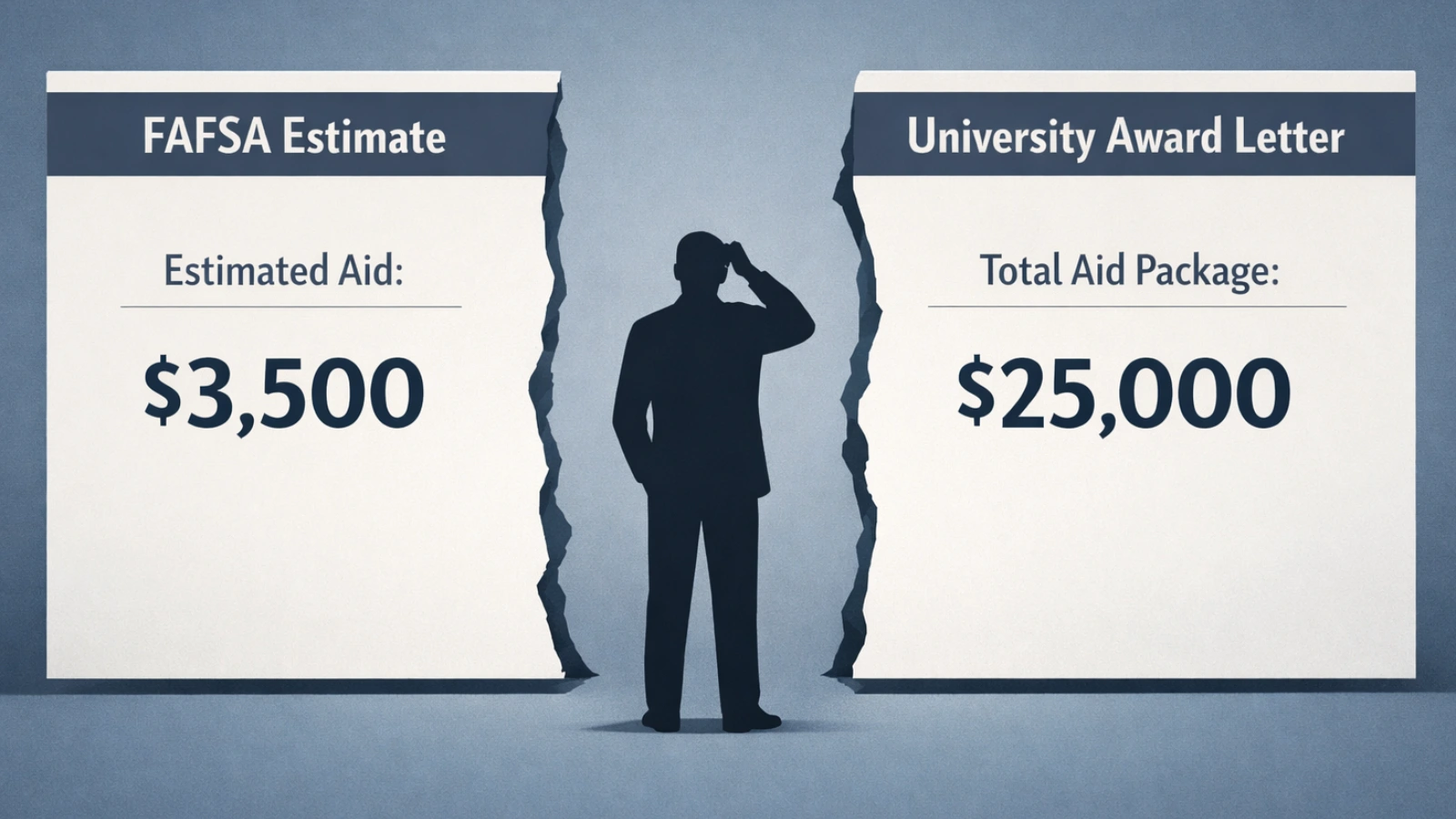
When the FAFSA processing email arrives, the estimated loan amount feels like it sets your entire budget. That initial figure creates a false sense of security about federal backing for the upcoming semester. Then, months later, the university issues the official financial aid award letter, and the numbers look completely different. The initial math is scrambled, creating the impression that the federal government and the school are working off two separate sets of books.
If the FAFSA shows a low initial number, that is one issue. If the school shows a completely different number later, that is another administrative hurdle.
When the final award letter fails to mirror the initial federal projection, it usually causes a spike in anxiety. Students assume a mistake was made, or worse, that their funding was slashed behind closed doors. But the discrepancy is almost never an error. It is simply the friction between a generic federal algorithm and the reality of campus billing.
Why the initial number is just a guess
The number you see on the StudentAid.gov confirmation screen is not a final contract. It is a baseline calculation operating on limited data.
When the federal system processes your tax information, it applies a standardized formula to determine baseline eligibility for federal aid. But the system is essentially flying blind about your actual academic life. It does not know if your program charges heavy lab fees, if you are living in an expensive city apartment, or if you need a $3,000 laptop for a design program.
The FAFSA system simply spits out a generic projection based on statutory limits. It is a one-size-fits-all receipt that ignores the actual financial mechanics of your university.
That’s where the mismatch begins.
FAFSA Loan Amount Too Low? Here’s What It Really Means
Grad PLUS Loan Not Showing on FAFSA? What’s Going On
How your school actually builds the bill
Financial aid offices do not copy and paste the federal estimate onto your ledger. They use FAFSA data as a starting point, but override it using a metric called the Cost of Attendance.
The Cost of Attendance is a localized budget. Your university calculates exactly what it costs to survive a year in their zip code, enrolled in your major. They factor in tuition rates, health insurance fees, transportation, and housing costs.
Because the school’s budget is detailed, your final borrowing ceiling moves. The school determines how much you are legally allowed to borrow based on their math, not the generic federal estimate.
Where the extra money comes from
The FAFSA estimate generally only confirms eligibility for standard federal loans, like the unsubsidized direct loan. But that base loan rarely covers a full year of tuition.
When the financial aid office runs their numbers, they identify the gap between your baseline loan and the actual cost of attendance. The university then builds a package to fill that void, often outlining eligibility for a Grad PLUS loan to cover the remaining balance.
This creates a visual discrepancy. The FAFSA showed a low baseline cap, while the school’s award letter shows a much higher borrowing capacity by stacking loan types together. The school shows the staircase; FAFSA only showed the first step.
How to Increase Your Loan Limit with a Cost of Attendance Appeal
FAFSA Submitted But No Aid Offer Yet? What Happens Next
The invisible timing gap
Sometimes the numbers change because of timing. There is a gap between when you file FAFSA and when the school generates your aid package.
You might submit paperwork in January, but the school might not finalize your award until May. In that window, tuition rates may rise, your enrollment status may change, or your living situation may shift.
If your status changes, your Cost of Attendance drops. By law, the school must adjust loan eligibility to match that lower need. FAFSA is a static snapshot; the school’s award letter is a live document reacting to your choices.
Fighting with the federal help desk over mismatched estimates is a dead end. The Department of Education does not cut the check; your university does. Once you have the official award letter, the FAFSA estimate becomes irrelevant. If the school’s final numbers do not cover your reality, your next move is contacting the campus financial aid office to negotiate adjustments. They hold the purse strings.
Loan rules are changing starting mid-2026, but FAFSA estimates and school award differences will still follow this structure.

Sarah Johnson is an education policy researcher and student-aid specialist who writes clear, practical guides on financial assistance programs, grants, and career opportunities. She focuses on simplifying complex information for parents, students, and families.