

Published: December 20, 2025
The traditional model of paper-based homework is rapidly fading in many U.S. classrooms. In its place is a leaner, more networked reality: the Chromebook, the tablet, and the learning management system (LMS).
By late 2025, the transition from worksheets to digital tools has moved beyond early adoption into mainstream practice in many districts. This isn’t just about reducing paper waste. It is a fundamental pedagogical shift driven by the need for instant data, personalized pacing, and the adaptation to an AI-driven environment.
Here is why schools are aggressively replacing the red pen with the dashboard.

The Speed of Feedback
The primary driver for teachers is the “feedback loop.” With traditional worksheets, a student might struggle with a concept on Monday night, turn the paper in on Tuesday, and not receive graded feedback until Thursday or Friday. By then, the class has moved on, and the misconception has cemented.
Digital platforms change this dynamic instantly. Tools used for math and science now provide immediate correctness feedback. If a student gets a problem wrong, the platform can instantly offer a hint, a video tutorial, or a simpler practice problem. This real-time intervention stops students from practicing mistakes for an hour.
The Rise of Adaptive Learning
Paper homework is inherently “one-size-fits-all.” Every student in the fifth grade usually receives the same fraction worksheet, regardless of whether they are performing at a sixth-grade level or struggling with third-grade concepts.
Digital tools in 2025 are increasingly “adaptive.” Leveraging algorithms, platforms from major nonprofit, commercial, and district-adopted providers now adjust the difficulty level based on the student’s performance.
Federal education technology guidance has long emphasized differentiation as a core benefit of digital tools. This functionality allows advanced students to move ahead without boredom, while struggling students receive foundational support without feeling overwhelmed by on-grade-level assignments they aren’t ready for.
The AI Factor: Rethinking What Homework Is
Perhaps the biggest disruptor forcing the hand of schools has been Generative AI. By late 2023 and throughout 2024, it became clear that traditional homework assignments, summarizing a chapter, writing a standard five-paragraph essay, or answering generic comprehension questions, could be completed by AI in seconds.
This reality has forced schools to abandon assignments that are easily “hackable.”
In 2025, digital homework tools are less about static output and more about the process. Platforms are now designed to track the steps a student takes to solve a problem, or they require interactive engagement that AI cannot easily replicate. The focus has shifted from “did you get the answer?” to “how did you arrive here?”
The Teacher Dashboard View
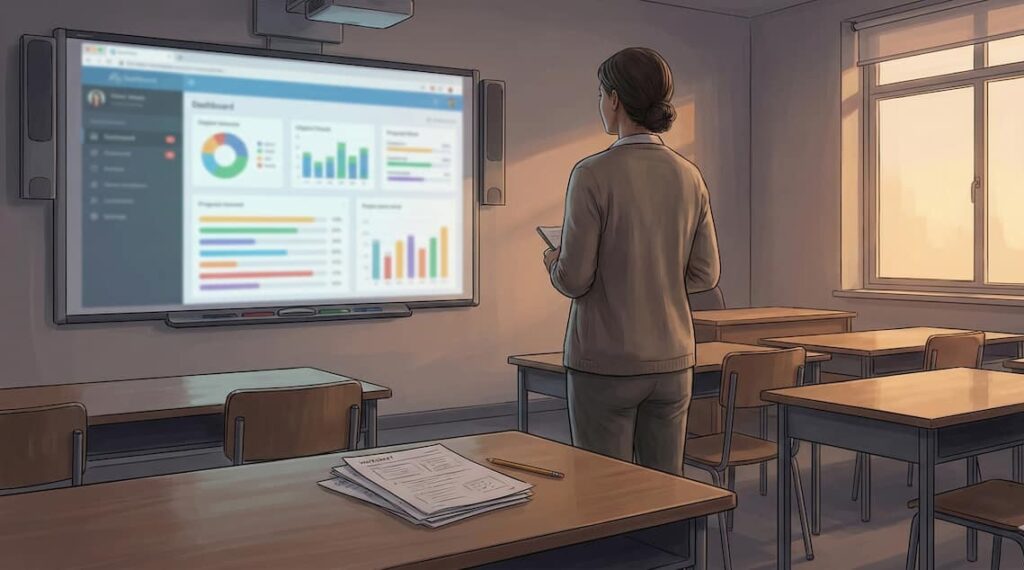
For educators, the shift is about actionable data. Instead of lugging home tote bags of papers to grade over the weekend, teachers open dashboards on Monday morning.
These dashboards show heat maps of student understanding. A teacher can see, in seconds, that 60% of the class failed question #4 on the digital homework last night. This allows the teacher to immediately reteach that specific concept at the start of class, rather than discovering the gap days later on a test.
The Persistence of the “Homework Gap”
Despite the benefits, the transition is not seamless. The shift to digital homework has heavily spotlighted the “homework gap”, the divide between students who have reliable high-speed internet and quiet places to work at home, and those who do not.
Data from the National Center for Education Statistics (NCES) and the FCC continues to show that while device penetration has increased, reliable broadband access remains inconsistent in rural and low-income urban areas. This gap increasingly determines whether digital assignments function as learning tools or barriers at home.
Consequently, schools adopting heavy digital workloads are forced to provide infrastructure solutions, such as checking out Wi-Fi hotspots along with laptops, or ensuring that digital assignments have robust “offline mode” capabilities so students can work on the bus or in homes without connectivity. The shift to digital is forcing schools to become de facto internet service providers to ensure equity.

For parents, this transition often requires a difficult adjustment. The ability to glance at a worksheet on the kitchen table and instantly gauge a child’s struggle is replaced by the opacity of a login screen. This “black box” effect can feel distancing for guardians accustomed to physical evidence of learning.
Yet, the objective of this digital migration is not to distance the family, but to make the student’s solitary practice more productive. As schools refine these tools, the goal is to move beyond mere compliance, ensuring that when a student opens a laptop at home, they are engaging with a system that supports their thinking rather than just recording their answers.
This article provides general analysis of educational technology trends based on data available through late 2025. Specific school district policies and tools vary significantly by region.

Sarah Johnson is an education policy researcher and student-aid specialist who writes clear, practical guides on financial assistance programs, grants, and career opportunities. She focuses on simplifying complex information for parents, students, and families.