Published: December 10, 2025
You check your student account balance and see a number $5,000 higher than you expected. You call the bursar, assuming it is a mistake, only to learn that the “automatic” renewal of your scholarship actually required a confirmation form you never saw.
The email was sent three months ago. It was buried under hundreds of campus announcements and spam. Because you didn’t have a tracking system, the deadline passed silently, and the funds were reallocated to a student who responded on time.
According to Federal Student Aid, families managing college financing typically juggle multiple deadlines. This often involves distinct deadlines across federal, state, institutional, and private aid sources.
Missing even one can eliminate thousands in funding that may be difficult or impossible to recover, and the complexity increases exponentially when multiple students attend college simultaneously.
The financial aid process doesn’t follow a single linear timeline. Different funding sources operate on independent schedules, some with rigid cutoffs and others with rolling consideration that may limit eligibility for late submission.
Families without organization systems often discover missed opportunities only after enrollment bills arrive.
CREATE A MASTER DEADLINE CALENDAR
Financial aid deadlines don’t align neatly with academic calendars or college application timelines. FAFSA may open in fall, state grants may have winter priority dates, scholarship applications might close in spring, and verification requests can arrive anytime between submission and disbursement.
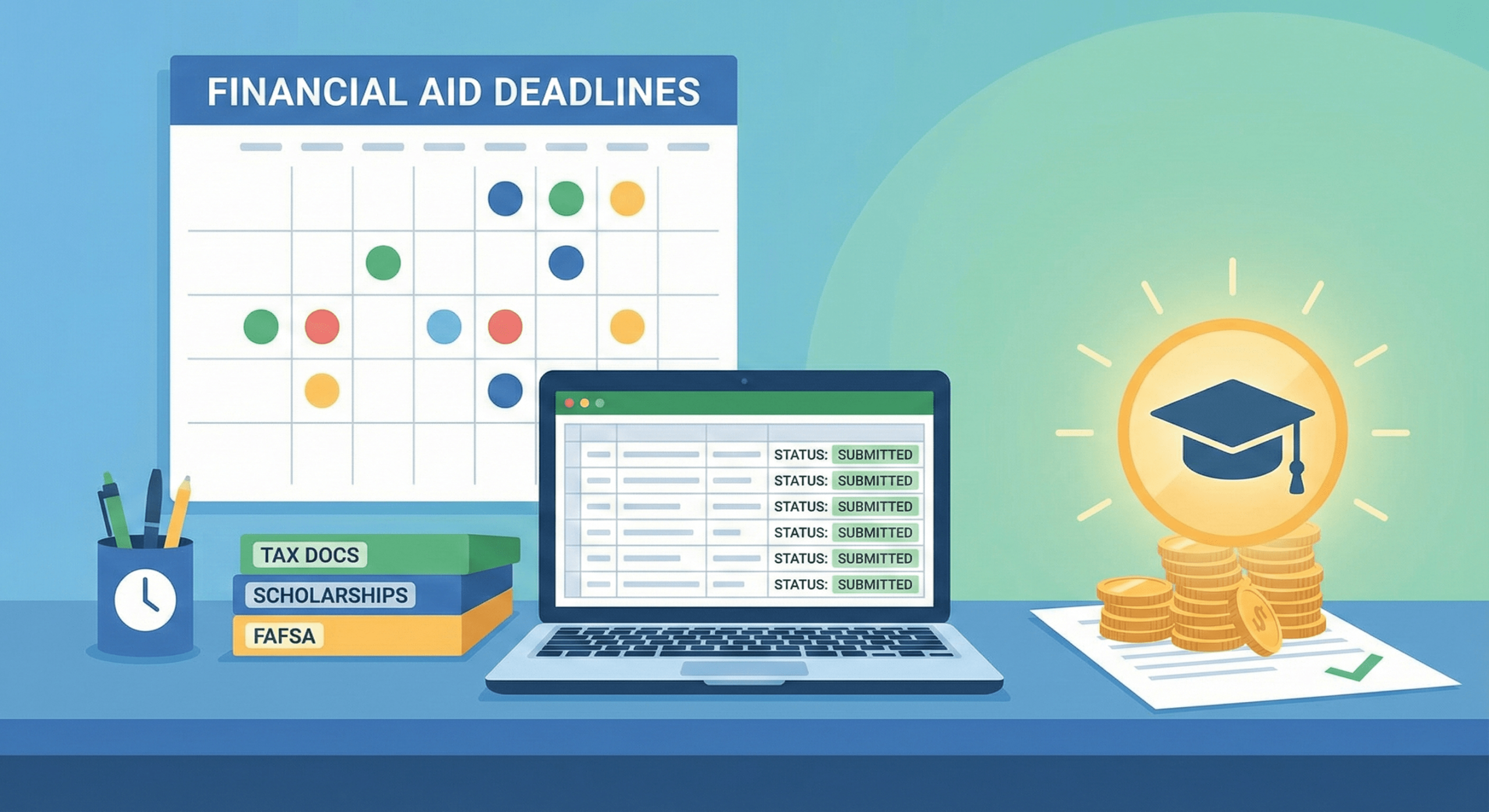
- Capture Everything: Build a single comprehensive calendar that captures every relevant date. Include FAFSA opening and submission deadlines, state grant priority dates, and college-specific financial aid deadlines.
- Alert Systems: Set alerts two weeks before each deadline, then again three days prior. The first warning provides time to gather documents and complete requirements without rushing.
- Visual Coding: Color-code deadlines by type: federal aid in blue, state programs in green, institutional requirements in red, private scholarships in yellow. Visual organization helps prevent confusion when multiple deadlines cluster.
The Implications: Many college-bound families manage over a dozen financial aid deadlines per student per year, and missing one can eliminate more aid than you’ll gain from all the others combined.
BUILD A DOCUMENT REPOSITORY
Financial aid applications require the same core documents repeatedly. Tax returns, W-2 forms, Social Security numbers, bank statements, investment records, and untaxed income documentation get requested by FAFSA, state agencies, and verification processes.
- Digital Access: Create a dedicated digital folder accessible from any device where you store PDF copies of all essential documents. Include current and prior year tax returns and recent pay stubs.
- Clear Naming: Organize documents by category and year with clear file names. “2024_Federal_Tax_Return.pdf” prevents confusion when you are rushing to upload materials before a deadline.
- Physical Backup: Keep both digital and physical copies of critical paperwork. Technology fails at inconvenient moments, and some processes still require mailed documents.
The Implications: Families who scramble to locate documents every time an application opens waste hours they could spend meeting deadlines, and the stress often leads to errors or missed submissions.
TRACK APPLICATION STATUS SYSTEMATICALLY
Submitting FAFSA or scholarship applications represents the beginning of the process, not the end. Applications move through processing, verification, award determination, and disbursement stages, each with potential delays or additional requirements that demand attention.
- The Tracker: Create a tracking spreadsheet with columns for application name, submission date, current status, required follow-up actions, and contact information.
- Portal Checks: Many financial aid portals don’t send email notifications for status updates. Check each college’s portal at least twice weekly during peak processing to avoid missing school forms issues.
- Interaction Logs: Document every interaction with financial aid offices. Record the date, person you spoke with, issue discussed, and resolution or next steps.
The Implications: Applications that sit in “pending verification” status for weeks because you didn’t see a document request can miss disbursement deadlines even though you filed on time initially.
ESTABLISH A WEEKLY REVIEW ROUTINE
Financial aid management can’t be a once-per-year task completed when FAFSA opens. New scholarships become available, state programs announce funding changes, colleges adjust requirements, and federal policies evolve throughout the year.
- Sunday Sessions: Set aside thirty minutes every Sunday evening during college years to review upcoming deadlines, check application statuses, and search for new opportunities.
- Information Filters: Subscribe to relevant email lists and newsletters. Filter updates from Federal Student Aid and your state’s higher education agency into a dedicated email folder you review weekly. Resources that explain why submitting FAFSA early matters can help families plan around priority deadlines.
- Community Intel: Join financial aid groups on social media or parent forums where families share deadline reminders and opportunity alerts. Collective knowledge helps everyone avoid missed deadlines.
The Implications: The scholarship worth $2,500 that you discover in April because you checked a database weekly beats the $10,000 scholarship you never found because you only looked in October.
DELEGATE AND SHARE RESPONSIBILITY
College-bound students should manage significant portions of the financial aid process themselves, but many families keep all organization tasks with parents. This creates bottlenecks when parents travel for work, face health issues, or simply forget amid other responsibilities.
- Division of Labor: Divide tasks based on capability and access. Students can monitor their email for college communications and check financial aid portals. Parents typically handle FAFSA completion and tax document retrieval.
- Shared Tools: Use shared digital tools like Google Calendar where both parties can see deadlines. When the student discovers a scholarship, they add it to the shared calendar immediately.
- Weekly Check-Ins: Create accountability check-ins where student and parent review progress together weekly. Confirming what got completed prevents assumptions and miscommunication.
The Implications: The application that neither parent nor student realized was the other person’s responsibility is the application that doesn’t get submitted, and the aid attached to it disappears permanently.
BUILD BUFFER TIME INTO EVERY DEADLINE
Technical failures, verification requests, missing documents, and processing delays occur regularly in financial aid systems. Families who treat deadlines as targets rather than absolute cutoffs create stress and invite failure.
- The One-Week Rule: Aim to complete every task at least one week before its actual deadline. This buffer accommodates unexpected problems without jeopardizing eligibility.
- Front-Loading Effort: Front-load effort in fall and winter when most critical deadlines cluster. Treating this as “financial aid season” with dedicated weekly effort prevents FAFSA meltdown 2025 parent guide scenarios.
- Pre-Launch Prep: Prepare documents before applications open. When you know FAFSA will require prior-prior year tax information, gather those documents in September.
The Implications: The family that submits FAFSA on January 25 and encounters technical issues has time to troubleshoot, while the family attempting submission on January 31 at 11 p.m. may miss the deadline entirely.
WHAT HAPPENS WHEN ORGANIZATION FAILS
Families without organization systems often report missing critical financial aid deadlines. Each missed deadline can cost anywhere from $500 for smaller scholarships to $5,000 or more for state grants or institutional aid.
- Compounding Costs: The cumulative effect compounds across college years. Missing a renewable scholarship deadline in freshman year doesn’t just cost you that year’s award but all subsequent years of eligibility.
- Forced Decisions: Disorganization creates emergency situations that force poor decisions. Families who realize too late they missed grant deadlines may accept unsubsidized loans with higher interest rates.
- Emotional Toll: The stress and conflict that deadline panic creates within families carries its own cost. Parents and students who fight about missed opportunities damage relationships during an already stressful transition.
The Implications: The hour per week you invest in financial aid organization could prevent avoidable financial losses over four years while preventing the emotional toll of preventable crises.
STARTING MID-YEAR WHEN YOU ARE ALREADY BEHIND
If you are reading this after missing deadlines, organization still matters for minimizing future damage. Create your systems now even if some opportunities have already closed.
- Failure Analysis: Document what you missed and why. Understanding your specific failure points helps prevent repetition. Did you not know the deadline existed?
- Remaining Options: Research what aid sources remain available mid-year. Some scholarships accept rolling applications, and federal work-study positions may still be open even if grant money depleted.
- Future Proofing: Set up systems before next year’s cycle begins. Getting organized in spring for fall deadlines provides months of runway to build habits and gather documents.
The Implications: You can’t recover money lost to missed deadlines, but you can prevent losing even more in subsequent years by implementing organization systems immediately.
School Aid Specialists provides news and analysis for informational purposes only. This content is not financial advice, legal advice, or a substitute for official government guidance. Financial aid regulations and FAFSA procedures are subject to change. Always verify deadlines and requirements with Federal Student Aid (StudentAid.gov) or your university’s financial aid office.

Sarah Johnson is an education policy researcher and student-aid specialist who writes clear, practical guides on financial assistance programs, grants, and career opportunities. She focuses on simplifying complex information for parents, students, and families.