
Published: December 22, 2025
Millions of borrowers have a narrow window left to avoid a potential IRS bill that could wipe out their savings.
The temporary federal rule that made student loan forgiveness 100% tax-free, the American Rescue Plan Act, officially expires on December 31, 2025. For the last five years, borrowers have enjoyed a “tax holiday” where cancelled debt effectively vanished without a trace. That holiday is about to end.
If your student loans are forgiven on or after January 1, 2026, the IRS will treat that cancelled debt as “taxable income.” This is not a penalty fee or a small surcharge. It is a fundamental shift in how the federal government views your financial relief. In high-balance cases, this change can create a surprise tax bill ranging from several thousand dollars to over $11,000, depending on your income and filing status.
This “Tax Bomb” is the single biggest financial threat facing student loan borrowers in the coming year, yet it remains buried in the fine print of tax code expirations. If you are waiting on forgiveness paperwork, a settlement offer, or an IDR adjustment, you need to understand exactly what is about to happen to your tax bracket.
The $11,000 Problem: How “Phantom Income” Works
To understand the threat, you have to understand how the IRS views debt. In the eyes of the tax code, borrowed money is not income because you have to pay it back. But the moment you are told you don’t have to pay it back, that money becomes a financial benefit.
Under normal IRS rules (which return in full force on January 1), cancelled debt is considered “Cancellation of Debt Income” (CODI). The government treats it exactly the same as if your boss handed you a cash bonus.
For the last five years, the American Rescue Plan suspended this rule for student loans. Starting next week, the suspension ends.
The Math: Why Your Bill Could Skyrocket
Let’s look at a realistic scenario for a borrower with a moderate balance.
Imagine you earn a salary of $60,000 per year. You have been paying on your loans for 20 years, and you finally receive forgiveness for your remaining balance of $50,000 in early 2026.
Without the American Rescue Plan protection, here is what happens to your tax return:
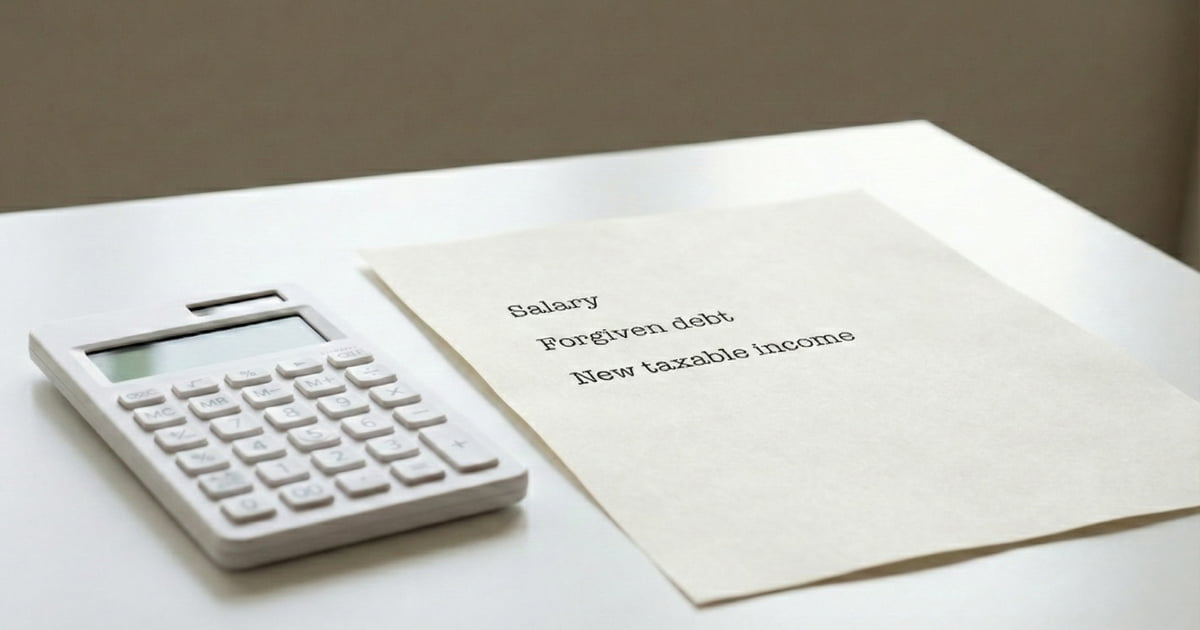
- Base Income: The IRS starts with your salary of $60,000.
- Phantom Income: They add the forgiven $50,000 to your total.
- New Taxable Income: Your “paper” income for the year is now $110,000.
You didn’t actually receive that $50,000 in cash. You can’t spend it on groceries or rent. But the IRS taxes you as if you earned it.
This jump does two dangerous things. First, it increases the total amount of income being taxed. Second, and more importantly, it can push you into a significantly higher tax bracket. A salary of $60,000 typically sits in the 22% marginal tax bracket. An income of $110,000 pushes into higher territory.
Instead of receiving a refund, you could suddenly face a tax bill for federal income tax on that extra $50,000. Depending on your deductions and state taxes, that could result in a check due to the IRS for $11,000 or more.

Who Is in the “Danger Zone”?
Not everyone will be hit by this. Public Service Loan Forgiveness (PSLF) is permanently tax-free by statute, so public servants are safe. However, millions of other borrowers are directly in the path of the Tax Bomb.
You are at immediate risk if you fall into one of these three categories and your forgiveness processes after the New Year’s Eve ball drops.
1. Income-Driven Repayment (IDR) Forgiveness
This is the largest group at risk. If you are on a plan like SAVE, PAYE, or IBR, you are promised forgiveness after 20 or 25 years of payments.
If you cross that finish line in 2026, every single dollar of your remaining interest and principal becomes taxable. For borrowers with runaway interest, where a $20,000 loan ballooned to $100,000, the tax implications can be catastrophic. You could owe taxes on money you never even borrowed in the first place, simply because interest accrued over decades.
2. Borrower Defense to Repayment
Tens of thousands of students who were defrauded by predatory schools have applied for Borrower Defense discharges. Many of these applications have been stuck in a processing backlog for years.
If your application is “Pending” right now, you are in a race against the clock. If the Department of Education approves your claim before December 31, it is tax-free. If they stamp “Approved” on January 2, it is taxable income. The delay in government processing could literally cost you thousands of dollars.
3. Total and Permanent Disability (TPD)
While the Tax Cuts and Jobs Act (TCJA) provided specific protections for death and disability discharges, provisions expire and interact with other tax laws in complex ways. Borrowers seeking disability discharge need to be hyper-vigilant about the timing of their approval, as the overlapping expiration of tax cuts in 2025 and 2026 creates a chaotic legal environment.
The “Insolvency” Safety Valve (Form 982)
Is there any way out? Yes, but it requires paperwork, math, and likely a tax professional.
The IRS offers an exception known as “Insolvency.” This is your primary defense against the Tax Bomb, but you must prove you qualify using IRS Form 982.
The Insolvency Rule essentially says: If you were broke before the debt was cancelled, we won’t tax you on money you don’t have.
To use this, you must compare your Total Liabilities (everything you owe) against your Total Assets (everything you own) immediately before the forgiveness happens.
- Liabilities: Student loans, credit card debt, mortgage, car loans, medical bills.
- Assets: The value of your home, your car (Kelley Blue Book value), your savings accounts, retirement funds (401k/IRA).
The Calculation: If your total debts are higher than everything you own at the time the loans are forgiven, you may be able to exclude part or all of that forgiven amount from your taxable income.
Example:
- You owe $100,000 in total debt.
- You own $40,000 in assets.
- You are insolvent by $60,000.
- If $50,000 of student loans are forgiven, you can exclude the entire $50,000 from your taxes because it is less than your insolvency amount.
The Catch: If you have a house with equity or a healthy retirement account, you might be “Solvent.” If your assets exceed your debts, you will owe the full tax. Furthermore, Insolvency is not automatic. You must file Form 982 with your tax return. If you forget this form, the IRS computers will automatically charge you the full tax.

Immediate Action Plan: 3 Steps Before Dec 31
You cannot force the federal government to move faster. You cannot make them process your form over the holidays. But you can prepare your defense.
Step 1: Document Your “Pending” Status
Log in to your student loan servicer’s portal today. Go to your account history or status page. If you see “Pending Forgiveness,” “Processing,” or “Awaiting Final Review,” take a screenshot with the date visible.
While this doesn’t change the tax law, having a paper trail proves when you qualified. If there is a future class-action lawsuit or a retroactive policy fix regarding processing delays, you will need proof that you were eligible during the tax-free window.
Step 2: Prepare Your Asset List Now
Do not wait until April 2027 to try to remember what your bank account balance was in January 2026.
If you anticipate forgiveness early next year, calculate your insolvency now. Print out your bank statements, check your car’s value, and list your debts as of December 31. Having a “snapshot” of your finances right as the tax year flips will make filing Form 982 significantly easier if you get hit with a 1099-C.
Step 3: Watch Your Mailbox for Form 1099-C
The most dangerous thing you can do is ignore IRS mail. If your loans are forgiven in 2026, the Department of Education is required to send you and the IRS a Form 1099-C (Cancellation of Debt).
Many borrowers mistake this for a receipt or a generic notice and throw it away. Do not do this. The IRS has a copy. If you file your taxes without including the income from the 1099-C (or offsetting it with Form 982), you will trigger an automatic audit or an underpayment notice plus penalties.
What Happens Next
The era of “free” forgiveness is ending. For the last few years, borrowers have been shielded from the true cost of debt cancellation. Starting January 1, the shield is lowered.
If you have a high balance and low assets, the Insolvency rule may save you. But if you are a middle-class earner with a home and a 401(k), the Tax Bomb is a very real, very expensive threat. Start saving now, because the tax system treats cancelled debt as income once the exemption expires, and the bill always comes due.
This article is for informational purposes only. Tax laws and student loan rules can change, and examples shown are illustrative. Consult a qualified tax professional for advice specific to your situation.

Sarah Johnson is an education policy researcher and student-aid specialist who writes clear, practical guides on financial assistance programs, grants, and career opportunities. She focuses on simplifying complex information for parents, students, and families.