Published: December 18, 2025
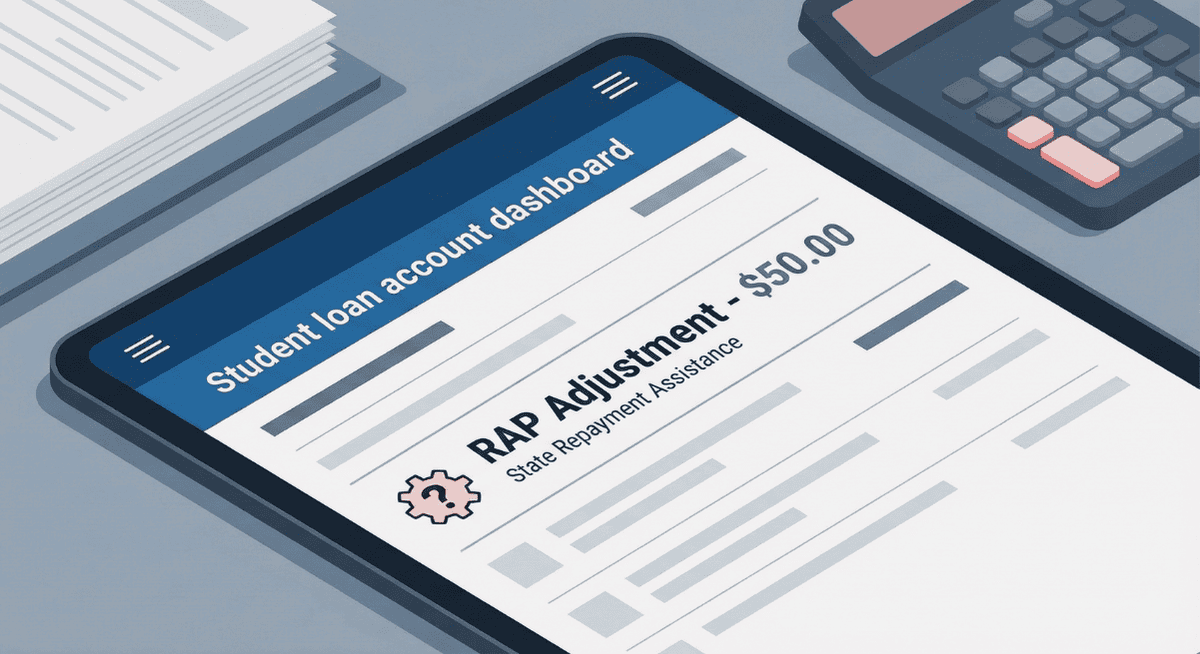
The payment confirmation arrives showing a lower amount than expected. Not zero, but $50 less than the calculated monthly bill.
The account dashboard offers no explanation. There is just a single line item labeled “RAP adjustment” that was not there last month.
Calls to the servicer produce scripted responses about “repayment assistance” without clarity on whether this is temporary relief, automatic enrollment, or something requiring action to maintain.
Repayment assistance programs operate in the space between standard payment plans and forbearance. They apply subsidies or adjustments that reduce what borrowers owe each month without changing the underlying loan terms.
These are not new federal programs announced with fanfare. They are often state-level or servicer-administered initiatives that activate based on eligibility triggers borrowers may not realize they met.
The acronym “RAP” itself lacks universal definition. It serves as a generic label on billing statements for a wide variety of distinct state-level and servicer-administered initiatives rather than a single standardized federal plan.
The confusion compounds when critical factors remain obscure. It is often unclear whether reduced payments will count toward forgiveness timelines, or whether interest continues accruing on the unpaid portion.
What appears as welcome relief carries questions about long-term loan trajectory.
Federal Versus State RAP Programs
Two distinct repayment frameworks now utilize the same acronym, creating a significant terminology overlap in borrower accounts.
A federal Repayment Assistance Plan (RAP) exists in statute. Scheduled to launch on July 1, 2026, this program functions as a specific federal income-driven repayment option intended to serve as a default income-driven option for new borrowers under current statute, subject to final Department of Education regulations.
However, the “RAP” label currently appearing on many servicer dashboards often does not refer to this upcoming federal plan.
Instead, servicers frequently use this code to designate state-level loan repayment assistance or third-party employer benefits.
When a borrower sees a “RAP Adjustment” today, it often reflects a subsidy from a state agency, such as a teacher or healthcare worker grant, rather than enrollment in the new federal IDR tier.
This shared nomenclature means borrowers must distinguish between the upcoming federal repayment plan and existing state repayment assistance.
Automatic Enrollment Versus Application-Based Programs
Some repayment assistance programs require formal applications with annual recertification.
Participants provide proof of eligibility criteria such as employment verification, income documentation, and state residency, and submit renewal paperwork to maintain benefits.
Other programs operate through data-sharing agreements between state agencies and federal servicers.
If state tax records or employment databases indicate qualification, the subsidy may apply automatically. The servicer receives notification from a state agency and updates the account proactively, even if the borrower never submitted a formal application.
A teacher working in a designated shortage area might suddenly see RAP adjustments without realizing their state offers loan assistance for educators in those regions.
How Subsidies Actually Apply
Repayment assistance typically does not reduce the loan principal directly. Instead, it covers a portion of the monthly payment obligation, reducing the out-of-pocket cost.
A borrower with a $300 monthly payment might receive $100 in monthly RAP benefits. They pay $200; the state program covers the remaining $100, which the servicer applies to the loan.
From the loan’s perspective, the full $300 payment posts. However, the cash outlay was only $200.
The timing matters for managing monthly cash flow. Direct-to-servicer programs reduce the bill immediately, while reimbursement models require full payment upfront, with refunds arriving weeks or months later.
Duration And Renewal Requirements
State repayment assistance programs typically impose time limits. Benefits might last 1, 3, or 5 years, after which they expire regardless of whether the initial eligibility criteria are still met.
Annual recertification requirements mean benefits do not automatically continue year to year. Missing a recertification deadline, often 60 or 90 days before the benefit year ends, can terminate assistance even if qualification continues.
Interest Treatment During RAP Participation
Whether interest accrues on the portion of payments covered by assistance depends on program structure and loan type.
If the RAP benefit pays the servicer directly and the full payment posts to the loan, interest accrues normally but gets covered by the combined borrower and assistance payment.
The loan behaves as if the borrower made the full payment themselves.
Programs structured as post-payment reimbursements can create gaps. If $200 is paid but the full $300 payment was due, the unpaid $100 might accrue interest until the reimbursement arrives and is remitted.
Delays between payment and reimbursement allow interest accumulation on the temporary shortfall.
Subsidized federal loans do not accrue interest during certain deferment periods, but RAP participation does not constitute deferment. The loan remains in active repayment status, and interest treatment follows standard repayment rules unless the program explicitly includes interest subsidy provisions.
PSLF And IDR Forgiveness Implications
Payments made with RAP assistance typically count toward Public Service Loan Forgiveness (PSLF) if PSLF requirements are otherwise met.
The source of funds does not matter. What matters is that qualifying payments posted while full-time employment for a qualifying employer was maintained.
Income-Driven Repayment (IDR) forgiveness timelines should also progress normally during RAP participation. The reduced out-of-pocket cost does not affect whether the payment counts as a qualifying payment toward the 20 or 25-year forgiveness threshold.
However, program-specific treatment can affect whether conflicts exist.
Some state assistance programs include provisions requiring participants to agree not to pursue federal forgiveness programs. This creates conflicts where accepting state assistance disqualifies federal forgiveness eligibility. These provisions are rare but do exist in certain state-specific programs.
The interaction between RAP and income-driven plans requires attention. If RAP covers the full payment amount, the out-of-pocket cost becomes $0.
Under IDR rules, $0 payments count as qualifying payments only under specific circumstances. The program structure determines whether the RAP-covered payment registers as a $0 payment (potentially not counting) or a full payment funded by third-party assistance (counting normally).
Tax Implications Of Assistance Payments
State loan repayment assistance may constitute taxable income under federal and state tax codes.
If a program pays $3,000 toward loans in a calendar year, that $3,000 might be reportable as income on the annual tax return.
Some programs include “tax gross-ups.” This is where the assistance amount increases to cover the anticipated tax liability. Other programs provide benefits without tax adjustments, leaving participants responsible for tax liability on the assistance received.
Servicer Communication And Transparency Issues
Federal loan servicers manage hundreds of thousands of accounts receiving various state assistance benefits, but system limitations often prevent clear communication about the source of the funds.
A MOHELA or Aidvantage account might show “RAP” without specifying whether it’s a teacher assistance program or a healthcare worker initiative. Determining exact program terms typically requires contacting the state higher education agency directly rather than the loan servicer.
When RAP Interacts With Other Benefits
Enrollment in income-driven repayment plans while receiving RAP assistance might create complex interactions between the two programs.
If IDR already reduced payments to $150 monthly based on income, and RAP provides $100 in assistance, the net payment becomes $50. The benefit from both programs applies simultaneously, though the compounded benefit might affect how quickly the loan balance decreases.
Most programs require active repayment status, meaning payments are posting to the loan.
Public Service Loan Forgiveness and RAP can work together, but strategic implications exist when these programs interact. If RAP pays the full monthly amount and PSLF is achieved in 10 years, the state essentially funded loan payments that would have been forgiven anyway.
Red Flags And Program Legitimacy
Legitimate repayment assistance programs are administered through state agencies or federal programs, never through private companies charging upfront fees.
Scams targeting student loan borrowers sometimes use “RAP” or similar terminology to suggest affiliation with official programs.
Any entity requesting fees to “enroll” in repayment assistance or “guarantee” approval should trigger immediate skepticism.
Official programs are listed on state higher education agency websites, servicer sites, or federal portals like StudentAid.gov.
Information should be verifiable through multiple official sources. Applications should be submitted directly to government agencies or through servicer portals, never through third-party intermediaries.
Calls about “new repayment assistance programs” require independent verification before personal or financial information is shared. Servicers and state agencies do not cold-call borrowers to offer enrollment in assistance programs.
Repayment assistance programs provide meaningful relief for eligible borrowers but operate through fragmented state and federal channels that create information gaps.
The benefits are real when programs align with borrower circumstances. However, the lack of centralized information and varying program structures require proactive research to identify opportunities and understand obligations that come with participation.
This article provides reporting on student loan repayment assistance protocols. It does not constitute financial, legal, or tax advice. Program details vary by state. Consult a qualified tax professional or your state higher education agency for specific guidance.

Sarah Johnson is an education policy researcher and student-aid specialist who writes clear, practical guides on financial assistance programs, grants, and career opportunities. She focuses on simplifying complex information for parents, students, and families.