
Published: December 15, 2025
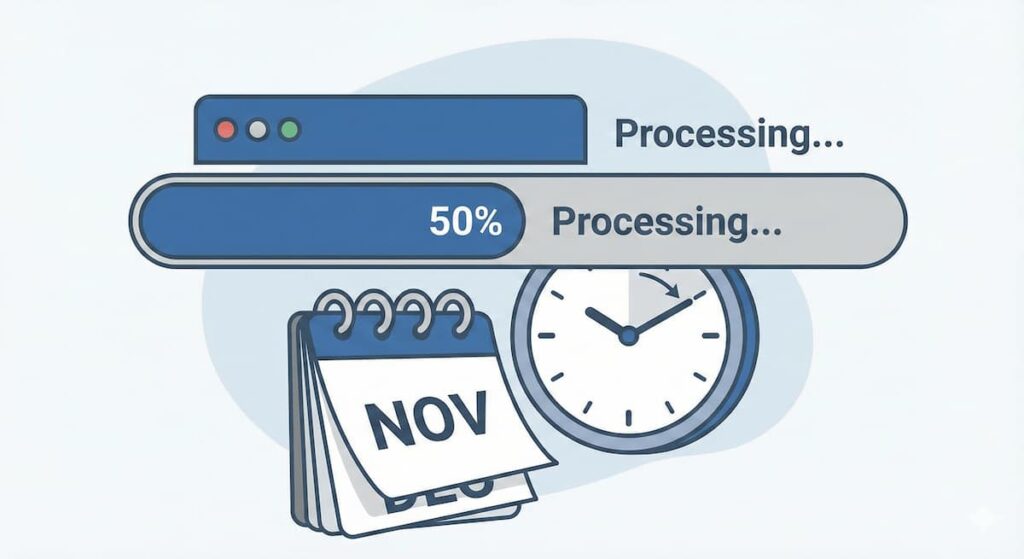
The portal has shown “processing” for six weeks. Other families report receiving aid packages. Meanwhile, many are already finalizing budgets for the upcoming semester.
You filed FAFSA in early November, checked every box, submitted every form the school requested.
The status hasn’t moved. No email explanation. No timeline. Just silence while tuition bills loom and decision deadlines approach.
Financial aid offices don’t process applications in the order received or with consistent timelines across institutions.
What appears as delay often reflects backend stages invisible to families: verification queues, data matching protocols, or manual review triggers.
The disconnect isn’t about whether FAFSA was filed correctly. It is about what happens after the federal government transmits the data.
Schools receive that information within days.
However, internal packaging, the stage where actual dollar amounts get assigned, operates on institutional schedules that bear no relationship to when families clicked submit.
Some colleges batch applications weekly. Others package continuously but prioritize certain applicant pools.
A few wait for committee meetings that occur monthly or quarterly.
Federal Student Aid completes its portion fast. What looks like delay is usually colleges working through multi-stage review processes that remain invisible until aid offers finally post.
The gap between submission and aid offer creates planning paralysis.
Families cannot finalize college choices, compare actual costs, or make informed enrollment decisions without knowing what aid will materialize.
December represents a particularly tense period as Early Decision and Early Action admits await packages that determine whether acceptance translates to attendance.
Information reviewed between November 2025 and January 2026.
Federal Processing Versus Institutional Packaging
FAFSA submission triggers a multi-stage process with distinct handoff points.
The federal processor receives the application, calculates the Student Aid Index (SAI), performs data validation checks, and transmits results to listed schools.
Under current systems, this federal stage typically completes within 3 to 5 days for error-free applications.
The data then enters each college’s financial aid management system. What happens next depends entirely on institutional practices.
Some schools begin packaging immediately upon receiving federal data. Others batch applications and process them in scheduled cycles weekly, biweekly, or monthly depending on staffing.
Institutional packaging involves calculating eligibility for school-controlled funds.
Merit scholarships, need-based grants from endowments, and state aid programs the college administers must all be aligned.
This stage can take anywhere from a few days to several months depending on the school’s resources and aid distribution methodology.
The portal status families obsessively check typically reflects the college system, not the federal processor.
“Processing” often means federal data arrived but institutional packaging hasn’t begun or completed yet.
Verification Selection Delays
Each year, a significant number of applications are selected for verification, though specific selection rates fluctuate by cycle and institution.
U.S. Department of Education regulations mandate verification for applications selected through federal algorithms or institutional choice.
Schools cannot disburse certain federal funds until verification completes.
Students flagged for verification receive notifications through email, portals, or paper mail requesting tax transcripts, W-2 forms, or identity documentation.
The request might arrive weeks after FAFSA submission, and processing cannot advance until families respond.
Verification backlogs intensify during peak periods. December through February sees the highest volume as fall FAFSA filers and spring semester packaging converge.
A school’s verification team might be processing October submissions while November and December filers stack up in queue.
Families who miss verification requests or submit incomplete documentation see their applications stall indefinitely.
The portal shows “processing” or “pending” without indicating that the hold stems from unreturned paperwork sitting in the verification office.
Institutional Packaging Cycles
Colleges operate on diverse packaging calendars that don’t align with FAFSA submission timing.
Some institutions package aid continuously as applications complete.
Others use batch cycles: processing all completed files from a two-week window simultaneously, then moving to the next batch.
Priority deadline structures create tiered processing.
Schools might package all applications received by the November 15 priority date in early December, then process later submissions in January or February.
Filing FAFSA in early November doesn’t guarantee December packaging if the institutional priority date was October 1.
Merit scholarship committees often meet on fixed schedules separate from need-based aid processing.
An application might show federal aid calculated but no institutional scholarships listed because the scholarship committee hasn’t convened yet.
Early Decision and Early Action timelines compress packaging windows.
Financial aid offices must assemble packages quickly to meet admission decision release dates, but this urgency applies only to ED/EA admits. Regular Decision applicants filed simultaneously might wait months longer.
What “Pending” Actually Indicates
Portal status language varies widely and often obscures what’s actually happening to the application.
“Pending” might mean federal data hasn’t arrived yet, or arrived but hasn’t been imported into the college system.
It could mean imported but awaiting verification clearance, or cleared verification but awaiting packaging.
Some schools distinguish between “incomplete” (missing required forms) and “under review” (actively being processed). Others use generic “processing” for all stages.
The status might not update in real-time.
Packaging could complete on a Tuesday, but the portal won’t reflect changes until the weekly batch update runs Friday night.
Families checking daily see no movement despite significant backend progress.
Technical integration issues between federal systems and college software can create status display errors.
The college might have the complete file and be actively packaging, but the portal still shows “awaiting FAFSA” due to a data sync failure.
State Aid Processing Timelines
State grant programs operate independently from both federal FAFSA processing and college packaging timelines.
Many states require separate applications beyond FAFSA, even though FAFSA data feeds into state eligibility calculations.
The state agency might need weeks or months to process applications during peak periods.
Priority filing dates at the state level can delay aid determination.
A student who filed FAFSA in November but missed their state’s October priority deadline might wait until the state completes its initial funding round.
State aid often appears on college financial aid packages but processes through state offices. The college cannot finalize the package until the state confirms award amounts.
If the state is backlogged, the entire package waits even though federal and institutional components calculated weeks earlier.
Some states operate on fixed disbursement schedules tied to legislative appropriations or fiscal year transitions.
Aid determination might not occur until January or February regardless of when FAFSA was filed.
CSS Profile Additional Layer
Private colleges requiring the CSS Profile in addition to FAFSA often cannot complete packaging until both forms arrive and process.
The CSS Profile operates on a separate timeline through the College Board. Submission to CSS Profile doesn’t automatically sync with FAFSA submission dates.
A family might file FAFSA in October but delay CSS Profile until November, creating a gap that prevents the college from beginning institutional aid calculation.
CSS Profile applications can also receive verification or clarification requests.
The College Board or individual colleges might ask for additional documentation, creating delays similar to FAFSA verification but through a different system.
Colleges using institutional methodology require CSS Profile data to assess family assets and home equity.
Without this information, the school can determine federal aid eligibility but not institutional grant amounts, leaving packages partially complete for extended periods.
Manual Review Triggers
Certain application characteristics trigger manual review that extends processing timelines significantly.
Special circumstances documented through financial aid appeals, such as job loss, medical expenses, or divorce, require individual attention.
These reviews happen sequentially as counselors work through queues, not instantaneously upon submission.
Business ownership or complex asset structures often require manual verification even without formal verification selection.
Aid officers must evaluate whether reported values align with tax documents and whether adjustments are appropriate under federal or institutional methodology.
Dependency override requests submitted alongside FAFSA require committee review. These determinations can take weeks or months.
International student documentation or non-citizen eligible student status verification requires collaboration between financial aid and international student offices.
Coordination across departments extends timelines beyond standard domestic application processing.
Early Decision Package Urgency
ED admits receive prioritized packaging because binding commitments require rapid financial clarity.
Financial aid offices typically fast-track ED applications, pulling them from standard queues for immediate processing once admissions decisions finalize.
This explains why some families receive aid offers days after acceptance while others wait months.
However, ED packaging urgency doesn’t override verification or missing document requirements.
An ED admit flagged for verification or missing CSS Profile faces the same delays as Regular Decision applicants until required materials arrive.
The compressed timeline creates pressure but not exceptions.
If the school needs tax transcripts for verification, the ED student must provide them just like anyone else.
Failure to comply quickly might result in admission deferral if the financial aid package cannot be assembled before the deposit deadline.
What Movement Looks Like
Portal updates typically occur in stages rather than all at once.
Federal aid components might post first: Pell Grant amount, loan eligibility, work-study allocation. These derive directly from FAFSA data and calculate automatically once verification clears.
Knowing the maximum Pell Grant for 2025–26 helps families sanity-check early aid postings, since Pell amounts are often the first federal dollars to appear once packaging begins.
Institutional grants and scholarships often appear later as separate line items.
The school might need additional committee approvals or budget allocation confirmations before posting these awards to student accounts.
State aid might populate last, after the state agency transmits award data to the college.
The package could show “incomplete” for weeks while waiting for state confirmation, even though all other components finalized.
Some colleges release preliminary packages showing only federal aid, then update later with institutional components.
Families see movement and assume the package is complete, only to discover weeks later that additional grants are still being calculated.
When Silence Becomes A Problem
Prolonged absence of communication or status updates can sometimes indicate problems families should investigate proactively.
If the portal shows “processing” for 8+ weeks with no verification requests, no status changes, and no email communication, direct inquiries have, in some instances, revealed underlying holds or missing documentation not visible on the dashboard.
The file might be stuck in a queue due to a missing document the automated system failed to flag properly.
Applications submitted well before priority deadlines but showing no progress by mid-December warrant inquiry.
Processing delays of this duration typically reflect specific holds, such as verification, missing forms, or special circumstances, rather than normal queue progression.
Comparing notes with other admitted students can reveal discrepancies.
If multiple students from the same school filed FAFSA simultaneously and others received packages while one hasn’t, that individual file likely has a unique issue.
Documentation And Follow-Up Patterns
Proactive status monitoring appears to correlate with faster resolution of hidden issues.
Families who check portals weekly rather than daily reduce anxiety while remaining attentive to status changes or new document requests.
Daily checking rarely reveals new information given batch update schedules.
Maintaining email folders dedicated to financial aid correspondence ensures verification requests or clarification inquiries don’t disappear into spam.
Calling financial aid offices after 6-8 weeks of no movement typically yields concrete information about what stage the application occupies.
Staff can often identify holds or missing elements not reflected accurately in portal status displays.
Documenting submission dates and confirmation numbers creates a record useful for resolving disputes. This documentation becomes critical if appeals or deadline extensions become necessary.
Comparing Institutional Speeds
Processing timelines vary dramatically across institution types and individual schools.
Large public universities often use automated systems that package straightforward applications quickly.
However, they create longer queues for applications requiring manual review.
Small private colleges with less sophisticated systems might process everything manually, creating consistent but slower timelines across all applicants.
Well-funded institutions with larger financial aid staffs typically process faster than under-resourced schools.
The same application submitted to two schools simultaneously might receive a package from one in two weeks and the other in three months.
Rolling admission schools often package aid as applications complete rather than waiting for priority deadline batches.
Schools using institutional methodology and requiring CSS Profile generally take longer to package than FAFSA-only institutions.
The additional data analysis and manual review involved in institutional methodology extends processing.
Understanding that timelines vary helps families calibrate expectations. An aid offer from one school doesn’t indicate others are behind schedule.
Families navigating the gap between submission and aid offer face uncertainty that numeric deadlines could mitigate.
The silence stems not from indifference but from complex backend processes operating invisibly to applicants.
This article provides general information about financial aid processing stages and institutional packaging timelines. Processing speeds vary significantly by institution, application complexity, and time of year. School Aid Specialists states that specific questions about individual application status should be directed to financial aid offices at the institutions where students applied.

Sarah Johnson is an education policy researcher and student-aid specialist who writes clear, practical guides on financial assistance programs, grants, and career opportunities. She focuses on simplifying complex information for parents, students, and families.