Published: December 14, 2025
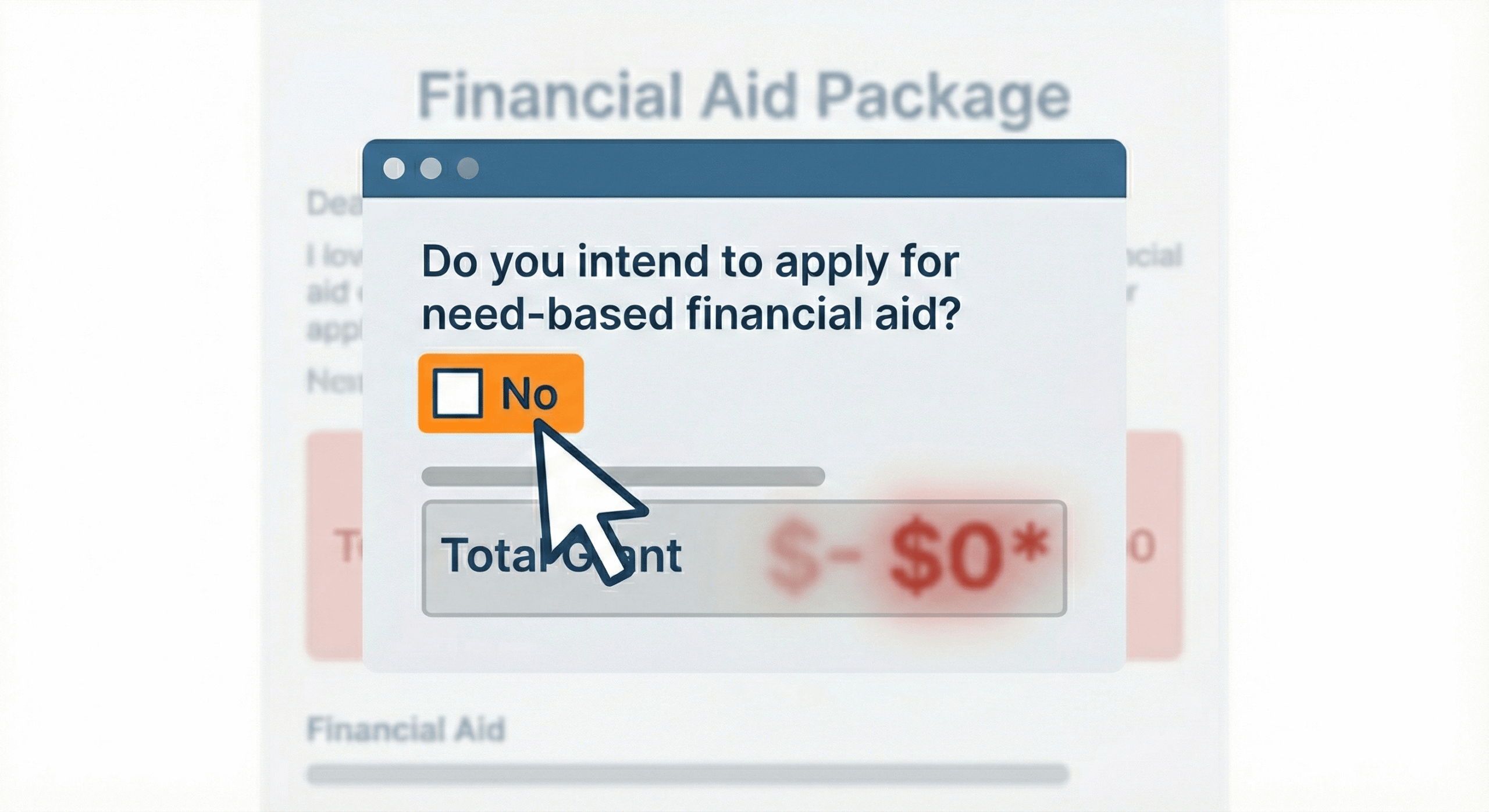
It is a single radio button on the Common Application. Buried in the demographics section, it asks a binary question: “Do you intend to apply for need-based financial aid?”
For a family worried about admission odds, or one assuming they will deal with finances later, the cursor often clicks “No.”
That single click can render a completed FAFSA invisible to the college.
Admission is granted. The celebration begins. Then the financial aid portal updates, and the institutional grant column reads $0.
The school did not calculate an aid package because the admissions application explicitly told them not to.
The Two-System Disconnect
Admissions and financial aid operate on parallel, often disconnected, tracks.
The Common App feeds the admissions office. The FAFSA feeds the financial aid office.
If the admissions file is flagged “No Aid Interest,” that data point frequently overrides the existence of a FAFSA in the initial packaging queue.
The college’s software sees an applicant who waived their right to funding.
While Federal Student Aid regulations confirm that FAFSA establishes federal aid eligibility for Pell Grants and Direct Loans, it does not compel a private institution to offer its own money.
Those discretionary institutional grants, often worth tens of thousands of dollars, require an affirmative request.
Without that “Yes” on the admissions application, the file sits dormant.
The Early Decision Trap
Timing makes this error fatal for Early Decision (ED) candidates.
ED acceptance is binding. The timeline from decision to deposit is roughly two weeks.
Because financial aid staff must assemble packages rapidly to meet the December release dates, they filter the list. Students who indicated “No interest” are skipped to prioritize those waiting for packages.
By the time the family realizes the mistake, the bulk of the need-based grant budget for that cycle may be allocated.
Correcting the record involves unwinding a completed admission file while the clock ticks toward the deposit deadline.
What “Financial Aid: No” Actually Means
The Common App question specifically asks about intent to pursue need-based aid.
Selecting “No” instructs the college to exclude the applicant from financial consideration.
Some families misunderstand the prompt. They believe it refers to federal aid only, or they confuse it with application fee waiver requests.
Others view the “No” selection as a placeholder, intending to correct it after acceptance.
This is a mechanical error. The selection functions as an administrative flag. Aid offices view the FAFSA submission as potentially exploratory rather than an active request for funds.
CSS Profile Versus FAFSA Confusion
Federal Student Aid requires the FAFSA for all federal programs. This is a universal requirement.
However, the CSS Profile is a separate instrument administered by the College Board.
Many private colleges require the CSS Profile to calculate their own institutional grants. It captures financial data that the FAFSA ignores.
Families who file FAFSA but skip the CSS Profile often receive federal aid but miss out on the larger institutional awards.
A student eligible for a $3,000 Pell Grant might miss a $25,000 university grant simply because the required institutional form was never filed.
Portal Messages That Get Missed
Colleges rarely stay silent about missing forms. They send automated reminders.
Notifications often land in November or December: “Your financial aid file is incomplete” or “We have not received your CSS Profile.”
If a family believes the FAFSA is the only required form, they often dismiss these alerts as system errors or spam.
Some portals explicitly display the financial aid status as “Not Requested” based on the Common App selection.
Families checking for admission decisions often overlook this status line. By the time the acceptance arrives, the priority aid deadline has passed.
“Need-Aware” Admission Concerns
Fear drives many “No” selections.
Applicants to need-aware institutions, which consider financial need in admission decisions, often believe requesting aid hurts their chances.
They attempt a strategic workaround: Apply “No” to secure admission, then file FAFSA to get paid.
This strategy often backfires.
Colleges cannot retroactively create institutional aid packages for students who explicitly did not request consideration by the published deadline.
The federal aid will still process. A $6,500 Direct Loan and a Pell Grant might appear.
But the institutional component, often the largest portion of the aid package, never materializes.
When Systems Diverge
Students who file FAFSA but click “No” on the Common App typically receive federal aid automatically.
The Pell Grant processes through the federal system regardless of the admissions application status.
Institutional grants follow the college’s internal rules. These usually require an affirmative indication of interest during the application window.
The resulting package shows a massive gap.
For a college with a $75,000 total cost, receiving only federal aid leaves a $66,500 balance. The family expected a comprehensive package, but the system only delivered the statutory minimum.
The Release Request Dilemma
Early Decision agreements are binding, but they contain a release clause for financial hardship.
Colleges must release students if the aid package is insufficient.
However, proving insufficiency is complicated when the package is low because the applicant failed to follow instructions.
Did the school fail to meet need? Or did the family fail to apply?
Some colleges take a strict line: The student did not request aid, so the full-pay package is accurate. Others may review the file more flexibly, but the outcome is never guaranteed.
State Aid Implications
Many state grant programs require both FAFSA filing and attendance at an in-state institution.
These awards process separately. They often appear on the package regardless of the Common App error.
If state grants are substantial, the package might still be viable at a public university. A $5,000 state grant plus federal aid can cover a significant portion of in-state tuition.
Private out-of-state colleges generally do not include these funds.
Students at these institutions face the full deficit of the missing institutional grant without the buffer of state aid.
Evidence And Documentation
When disputes arise, the paper trail becomes the only defense.
Successful appeals often rely on documentation showing exactly what was submitted and when.
FAFSA Confirmation Pages: These include transaction numbers and dates that prove federal filing occurred timely.
Common App PDFs: Submission confirmations reveal exactly which box was checked. If the family clicked “Yes” but the system recorded “No,” this document is critical.
Email Archives: If a college claims they sent missing document reminders, checking email logs establishes whether those messages were received or buried.
Administrative Verification Strategies
Administrative clarity prevents the crisis.
Cross-Platform Alignment: Successful applicants ensure the Common App says “Yes,” the FAFSA lists the school, and the CSS Profile is submitted.
Portal Audits: Checking the financial aid portal weekly after submission identifies “Not Requested” flags before decision day.
Proactive Confirmation: Contacting the financial aid office in November to verify file completeness catches discrepancies while correction is still possible.
Data reflects application processes and federal guidance available through early 2026.
This article provides general information about financial aid application processes and administrative disconnects. Individual college policies regarding aid application corrections vary. School Aid Specialists states that specific questions about aid status should be directed to the financial aid office at the institution of application.

Sarah Johnson is an education policy researcher and student-aid specialist who writes clear, practical guides on financial assistance programs, grants, and career opportunities. She focuses on simplifying complex information for parents, students, and families.