Published: November 27, 2025
Last Updated: December 11, 2025
Important Update (Late 2025): The “RAP” Plan and “One Big Beautiful Bill” are currently legislative proposals. They have not yet passed into law. This guide breaks down the proposed rules so borrowers can prepare for potential changes in 2026.
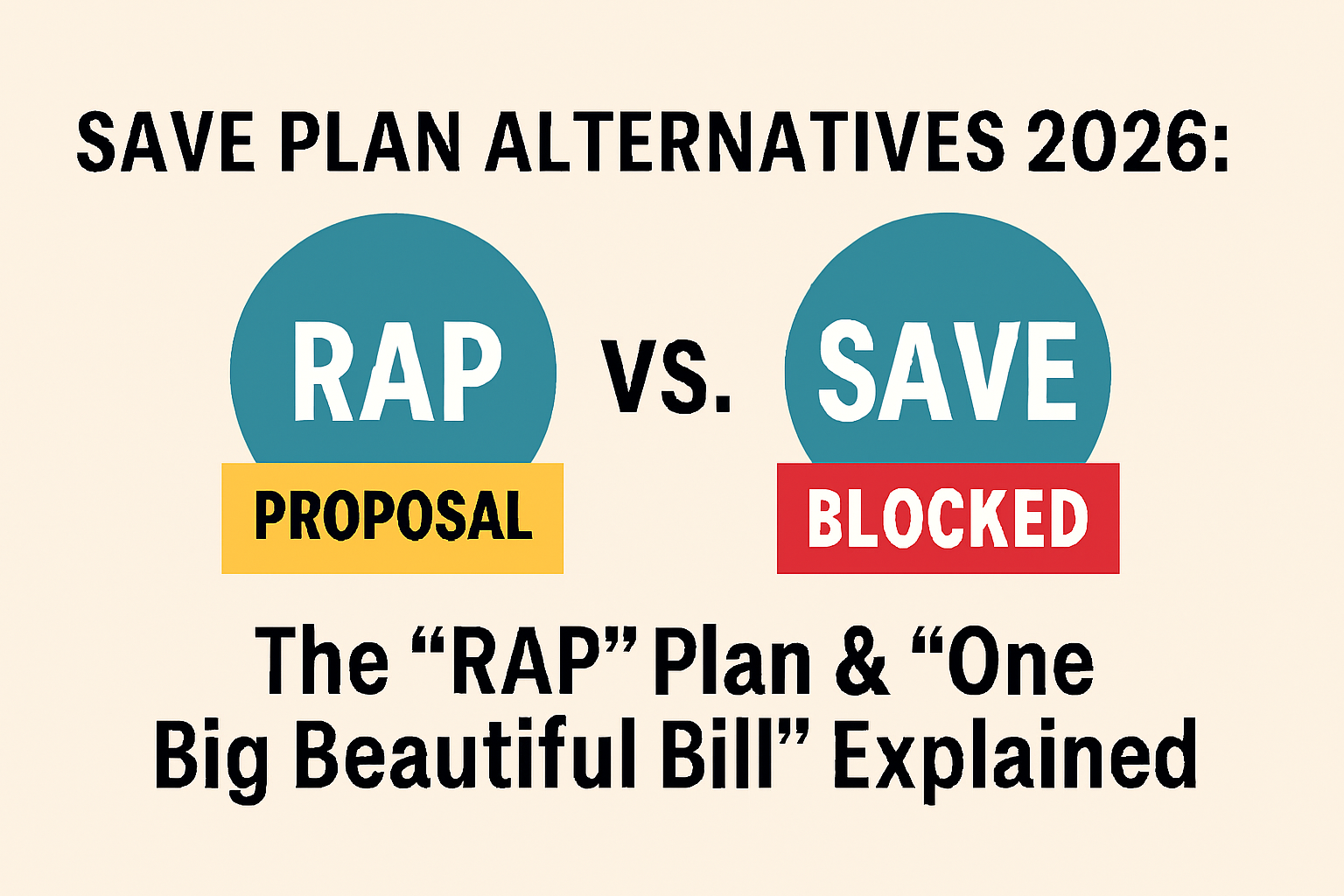
Millions of borrowers are preparing for major changes in 2026. With the SAVE Plan blocked by federal courts, the government is considering replacing it with two new frameworks: the “RAP” Plan and the “One Big Beautiful Bill” (OBBBA).
Both proposals aim to simplify the student loan system, but they come with stricter rules than the SAVE plan. This guide explains what each proposal means, how your monthly payment could change, and the three steps you should take now.
Why Is the SAVE Plan Being Replaced?
The SAVE Plan offered the lowest monthly payments in history, but it faced immediate legal challenges. In 2024 and 2025, federal courts (including the 8th Circuit Court of Appeals) blocked key parts of the plan, arguing that the Department of Education exceeded its authority.
To prevent future lawsuits, lawmakers have proposed OBBBA—a new law that would “codify” repayment rules so they cannot be easily blocked by courts in the future.
Proposal 1: The RAP Plan
RAP stands for Repayment Assistance Plan. It is designed to be the only income‑driven repayment option for most borrowers starting July 1, 2026.
Key Features (Proposed):
- $10 minimum payment for all borrowers, even those with low income
- Sliding scale payments from 1% to 10% of Adjusted Gross Income (AGI)
- Interest waived if payments don’t cover it, so balances don’t grow
- Up to $50/month applied directly to principal to reduce debt faster
- Forgiveness after 30 years (longer than SAVE’s 20–25 years)
Proposal 2: The One Big Beautiful Bill (OBBBA)
While RAP is the repayment plan, OBBBA is the larger system overhaul that would house it. The goal is to modernize the entire student loan system.
How OBBBA Would Change Things:
- Unified servicing through a single portal instead of multiple servicers
- Automatic IRS income data sharing, eliminating manual recertification
- One standard rule for all borrowers, replacing PAYE, ICR, and IBR
Scenario: SAVE vs. RAP for a Middle‑Income Borrower
Let’s compare how a borrower earning $60,000 per year would fare under each plan:
| Feature | SAVE Plan (Current) | RAP Proposal (2026) |
|---|---|---|
| Deduction | Deduct $32,800 (225% Poverty Line) | None (Pay on Adjusted Gross Income) |
| Payment Formula | 5% of Discretionary Income | Marginal Rate (approx. 3–4%) |
| Estimated Bill | ~$113 / month | ~$150–$180 / month |
| Forgiveness | 20 Years | 30 Years |
Verdict: Middle‑income earners ($40k–$70k) will likely pay more under RAP because they lose the generous Poverty Line Deduction offered by SAVE.
3 Things Borrowers Should Do Now
While we wait for these laws to be finalized, here are three smart steps to protect your finances:
- Review IBR Information Some borrowers are looking at the Income-Based Repayment (IBR) plan because it is established in federal law and continues to count qualifying payments toward forgiveness timelines.
- Update Your Contact Info OBBBA relies on strict communication and automatic data sharing. Borrowers can review their email and mailing address at StudentAid.gov to ensure they receive official updates in 2026.
- Review Your Budget RAP may result in higher payments than SAVE for some borrowers, so reviewing monthly expenses ahead of potential changes in 2026 may help with planning.
The student loan landscape is shifting from temporary executive orders to permanent congressional law. While the new proposals offer stability, they come at the cost of higher minimum payments and longer forgiveness timelines. Stay informed, and borrowers can monitor federal announcements and review available repayment plans while these proposals move through the legislative process.
This article is for general informational purposes and reflects publicly available federal proposals as of the latest update. It is not financial, legal, or tax advice. Borrowers should confirm details with the US Department of Education or their loan servicer.

Sarah Johnson is an education policy researcher and student-aid specialist who writes clear, practical guides on financial assistance programs, grants, and career opportunities. She focuses on simplifying complex information for parents, students, and families.